
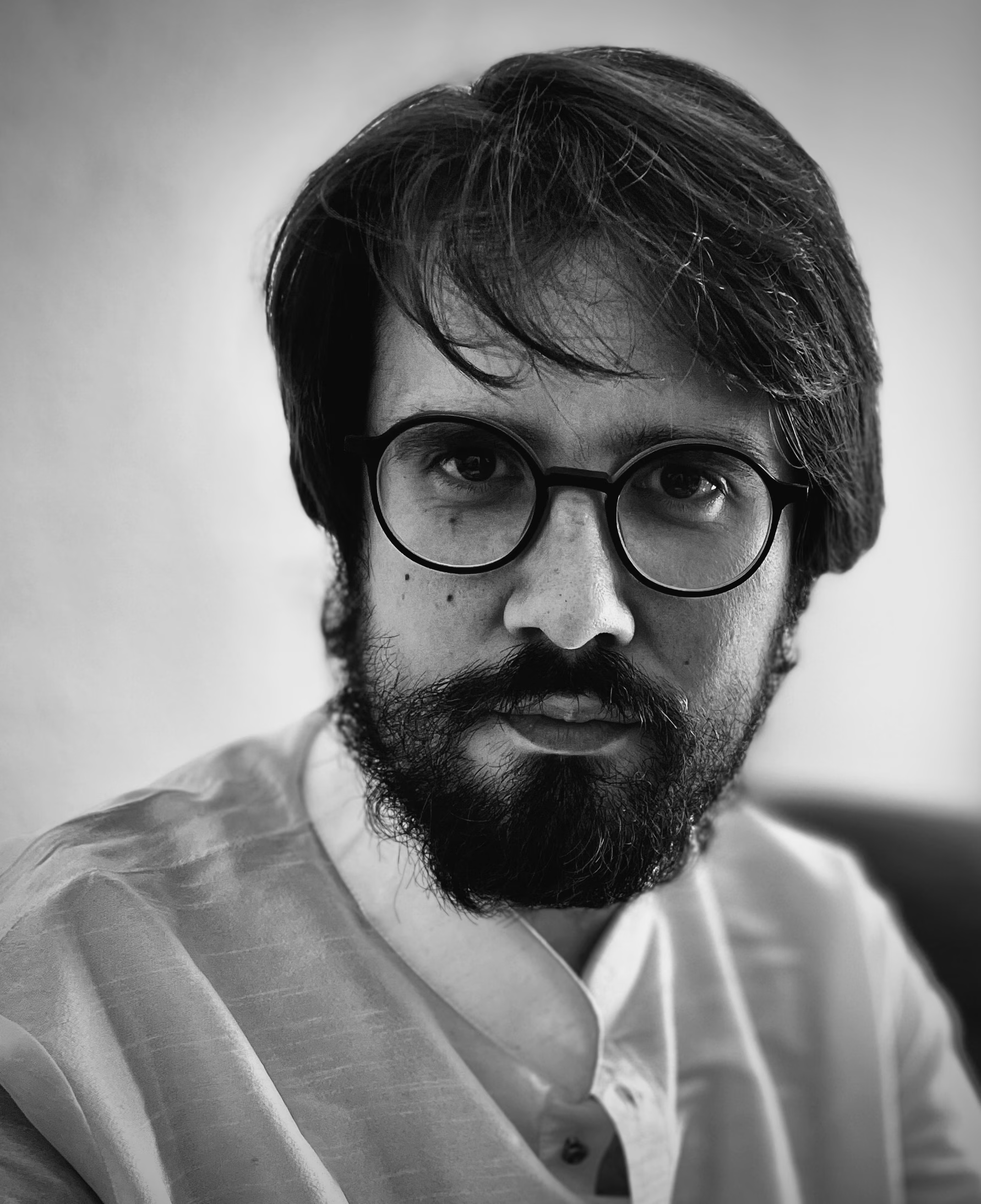
Antonio de Diego González
…is a Spanish philosopher, anthropologist, writer, and translator whose research moves between Islamic and Western Esotericism, Jungian thought, and symbolic anthropology. He unites scholarship and practice. Initiated into several Western esoteric paths and rooted in the practice of West African Sufism, he approaches esotericism not merely as an academic field, but as a living path of knowledge and transformation. He is currently Associate Professor of Philosophy at the University of Málaga, Spain, where he teaches courses on Ancient and Medieval Philosophy and the History of Esotericism. He is also a full member of the European Society for the Study of Western Esotericism (ESSWE).
He has authored more than fifty publications, including:
- Ley y gnosis: Historia de la Tariqa Tijaniyya (Universidad de Granada, 2020),
- Eucaristía en el Infierno: Ontología de las visiones primigenias de C. G. Jung (El Hilo de Ariadna, 2025),
- Esoterismo islámico (Almuzara, 2026).
De Diego González is also the translator of a new Spanish edition of the Qur’an (Almuzara, 2024).
Forthcoming works for Theion (expected late 2027 / early 2028):
The first book for Theion is an exploratory commentary on C. G. Jung’s Black Books (1913–1932), approached not merely as psychological or historical documents, but as records of a chthonic descent through active imagination, dæmonic figures, ancient gods and imaginal symbols. At its centre lies a dark and buried gnosis of the soul, in which shadow, catastrophe, and the numinous become thresholds of transmutation. The work seeks to recover Jung beyond the received image: a visionary of the Zwischenwelt whose passage among the primordial images and powers of the collective unconscious reveals the possibility of spiritual renewal in a secularized world that has forgotten the language of the numinous.
The second book is a forthcoming edition and study of MS 6666: Cagliostro’s Egyptian Masonry, an extraordinary testimony to alchemy, theurgy, and initiatic resistance against the Enlightenment-born modern world. Beyond presenting the manuscript itself, the volume reconstructs a fascinating textual history of lost, displaced, and recovered sources, while tracing its esoteric antecedents and later influence, from ancient theurgy and Rosicrucian symbolism to the SRIA, the Golden Dawn and the French occult revival surrounding Papus. It presents Cagliostro’s Egyptian Masonry not as a historical curiosity, but as a living document of theurgical practice, initiatic imagination, and counter-modern gnosis.